
For Employers & HR
Verify your foreign workers understand your safety protocols and daily operations — before their first shift
Built for facilities onboarding 25+ international or seasonal workers a year. Workers practice your equipment vocabulary, lockout/tagout, shift handoffs, and team radio calls by voice — so supervisors stop repeating protocols on a noisy line.
One production line. 30 days. $2,500 flat — credited in full against your annual plan. No procurement, no IT project, no hardware.
Safety protocol rehearsed: Ready for shift
Product proof
Practice by voice. Prove by name.
Three artifacts a plant manager can recognize in under ten seconds — no LMS, no hardware.
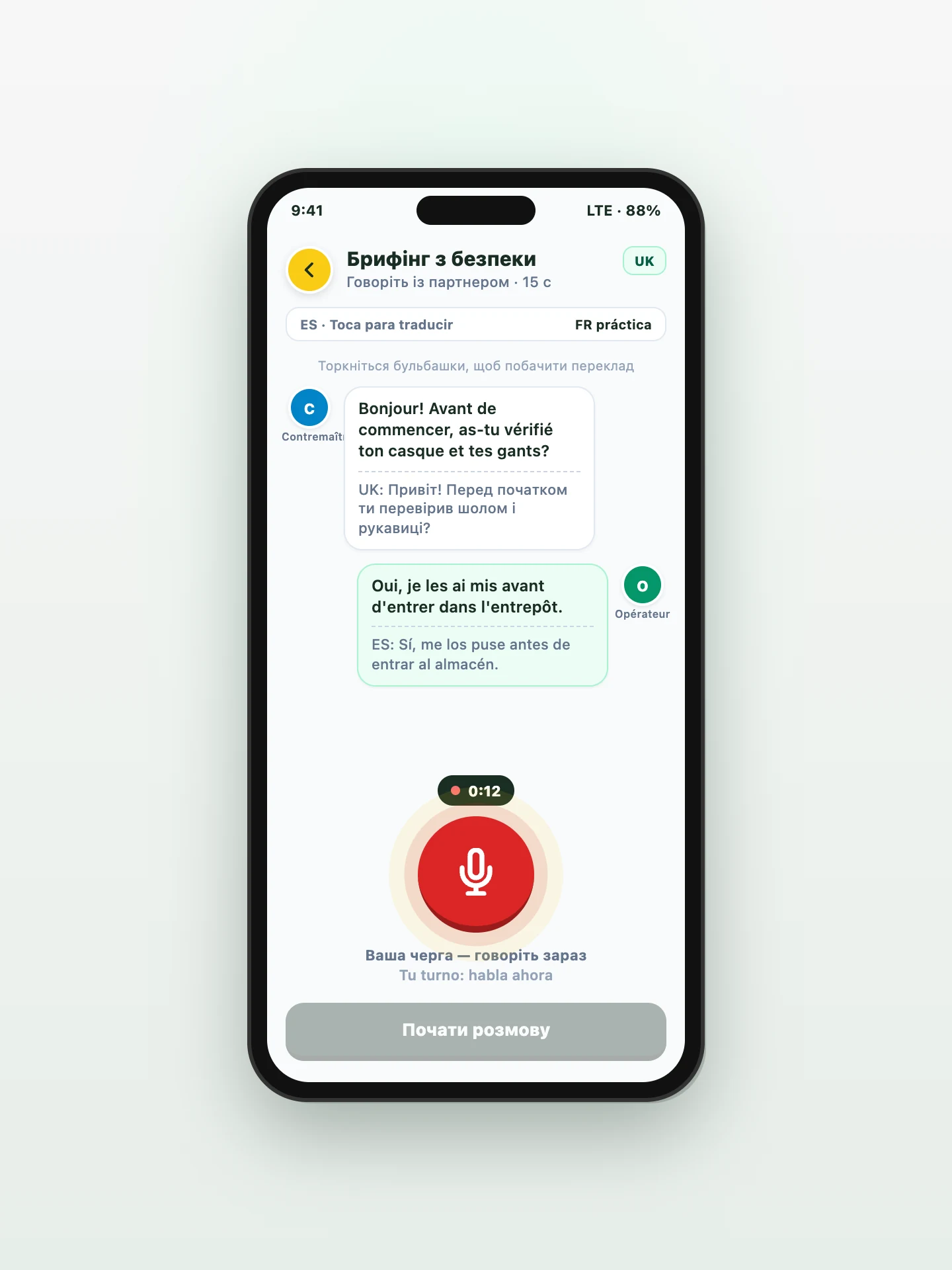
Worker phone
Voice drill: AI supervisor prompt + push-to-talk reply before the shift.
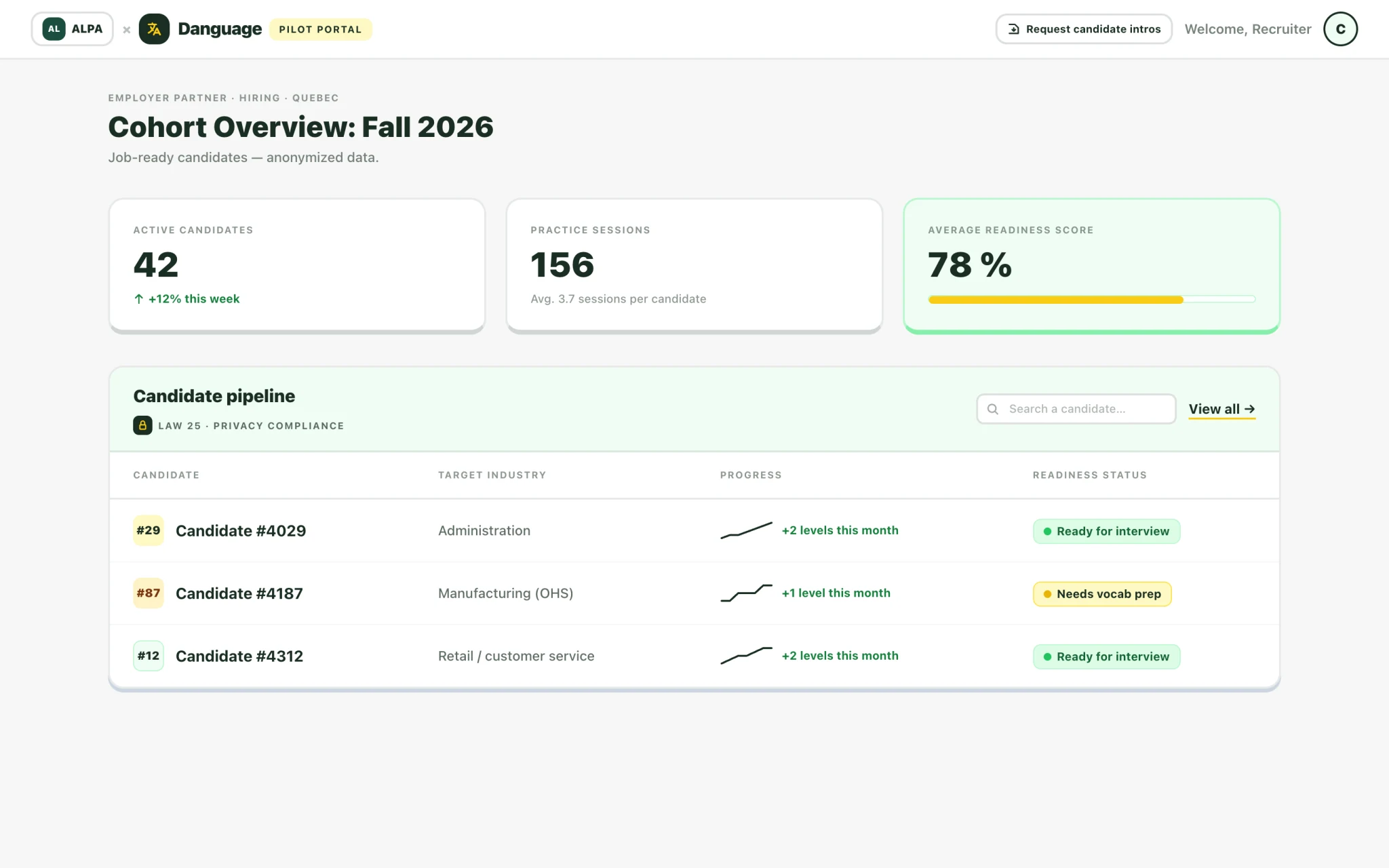
Ops roster
Named workers, roles, and readiness status — Verified / Needs practice / Inactive.
Scorecard PDF
Per-protocol Pass / Needs review with an audit footer Ops can file.
CNESST risk mitigation
Protect your floor — and your supervisors' time
Stop repeating safety instructions on a noisy plant floor
Language barriers are a leading communication risk in the first weeks of work. Floor supervisors do not have time to repeat lockout/tagout, emergency-stop, and sanitation protocols ten times. Danguage ensures new hires have already practiced your exact floor vocabulary by voice before their shift — reducing communication-related safety risk, cutting delays, and removing supervisory friction.
Cost of a failed hire
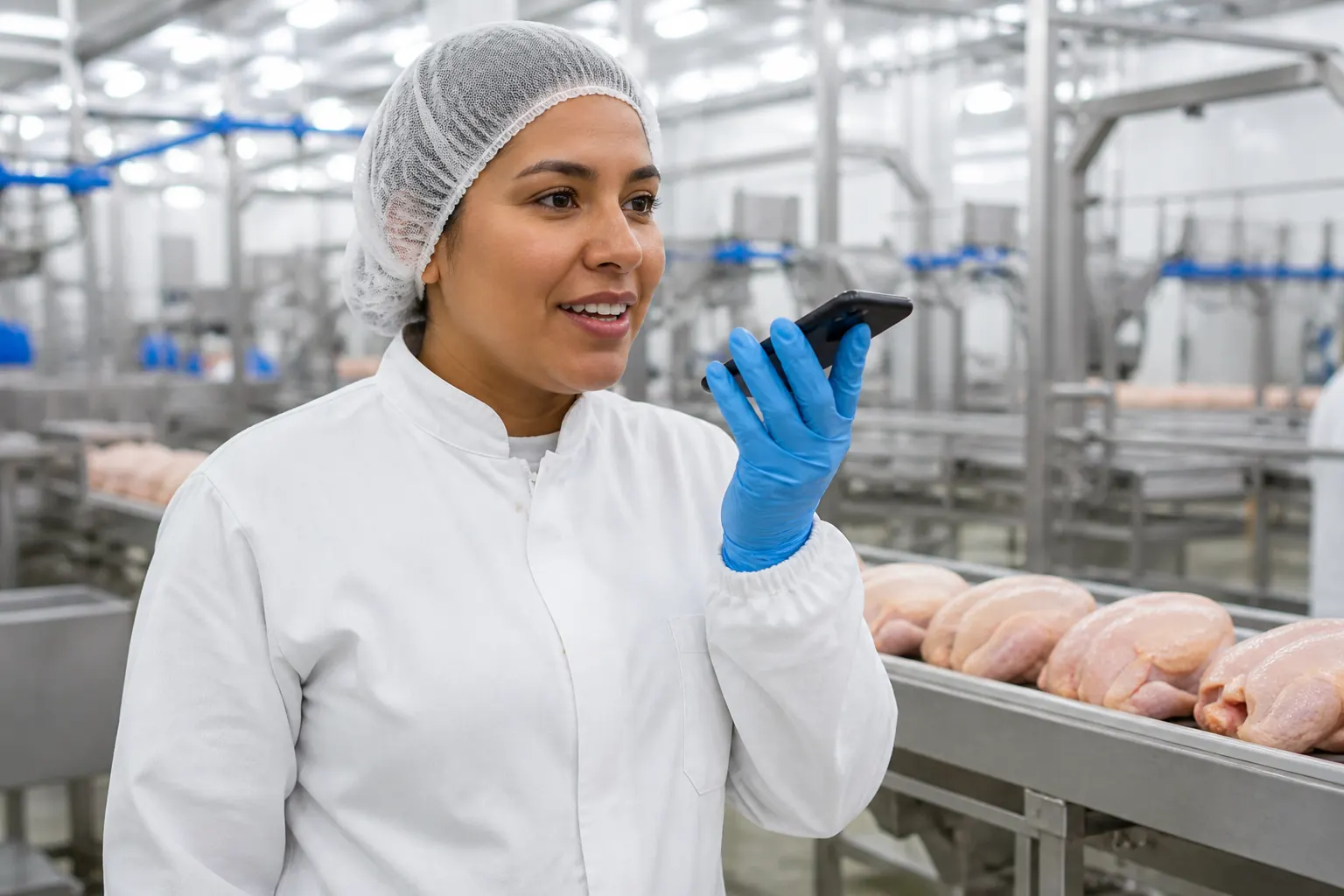
You already paid to get this worker to your door
Losing them in week six writes off the entire acquisition cost
LMIA processing, recruitment, travel, and housing routinely run thousands of dollars per temporary foreign worker before they produce anything. A hire who cannot follow floor instructions in week one is often the hire who leaves in week six — and you pay the acquisition cost again. A misunderstood protocol also risks a CNESST citation, lost-time incident, or line downtime. Verifying comprehension before the first shift protects both the investment and the floor.
Time to floor
Get workers safely on the production floor faster
Cut orientation days lost to language-barrier friction
Operations managers cannot afford slow onboarding. Danguage shortens the days spent repeating the same instructions — so workers reach safe productivity faster, with proof they understand what they hear on the floor.
Workplace Simulation
Build confidence for the daily interactions that keep lines moving
It is not just about safety; it is about team cohesion
Danguage simulates everyday workplace friction — like reporting a jammed machine, asking for clarification on a shift handoff, or responding to a radio dispatch. Workers build the spoken confidence they need to actually integrate into your teams, preventing isolation and reducing early turnover.
Certified SST training
This does not replace your certified safety training
Danguage runs before certified SST — and makes it stick
We are not a substitute for certified SST courses, and we do not claim to be. Workers practice the vocabulary and verbal protocols of your floor so the training you already pay for lands. Think of it as the rehearsal before the certified session — not a replacement for it.
After the interpreter leaves
Interpreters cover the first 30 days. Then what?
Paid interpreters disappear. Floor instructions do not.
Human interpreters are vital for the first weeks — and they are a real line item. When they leave, workers still need to understand the foreman without a relay. Danguage is the autonomous practice layer that takes over: workers rehearse technical French or English and safety codes on their phone so day 31 is not a cliff.
Crew language risk
When the crew speaks only to each other, the floor stays unsafe
Mother-tongue bubbles stall comprehension of verbal protocols
Temporary foreign worker and seasonal cohorts often rely entirely on their native language with peers. That stalls progress in the language of the floor — and leaves a crew that cannot take verbal safety instruction at month six. Danguage forces autonomous vocalization of supervisor instructions, breaking the bubble without pulling a foreman off the line.
Zero admin burden
Zero course building. Live in 48 hours.
No LMS to manage, no curriculum to design, no IT project
Plug-and-play modules built for your floor machinery and technical pipelines. We configure industry modules, workers start practicing on their phones, and automated readiness reports go directly to Operations and HR.
Zero hardware
Runs on their phone — not your budget
No tablets, kiosks, or floor terminals to buy or manage
Workers complete voice simulations on their personal smartphones before their shift starts — BYOD means zero company hardware and zero IT rollout on your floor
Floor-ready vocabulary
Built for the environments you run
Workers autonomously practice the exact vocabulary surrounding sanitation rules, lockout/tagout (cadenassage), emergency protocols, and daily team communications for the environment they will operate in — not generic small talk

Agriculture & agri-food
Norms, machinery, and seasonal workflows
Poultry & egg processing
Line sanitation, cold-chain handling, and plant-floor safety codes
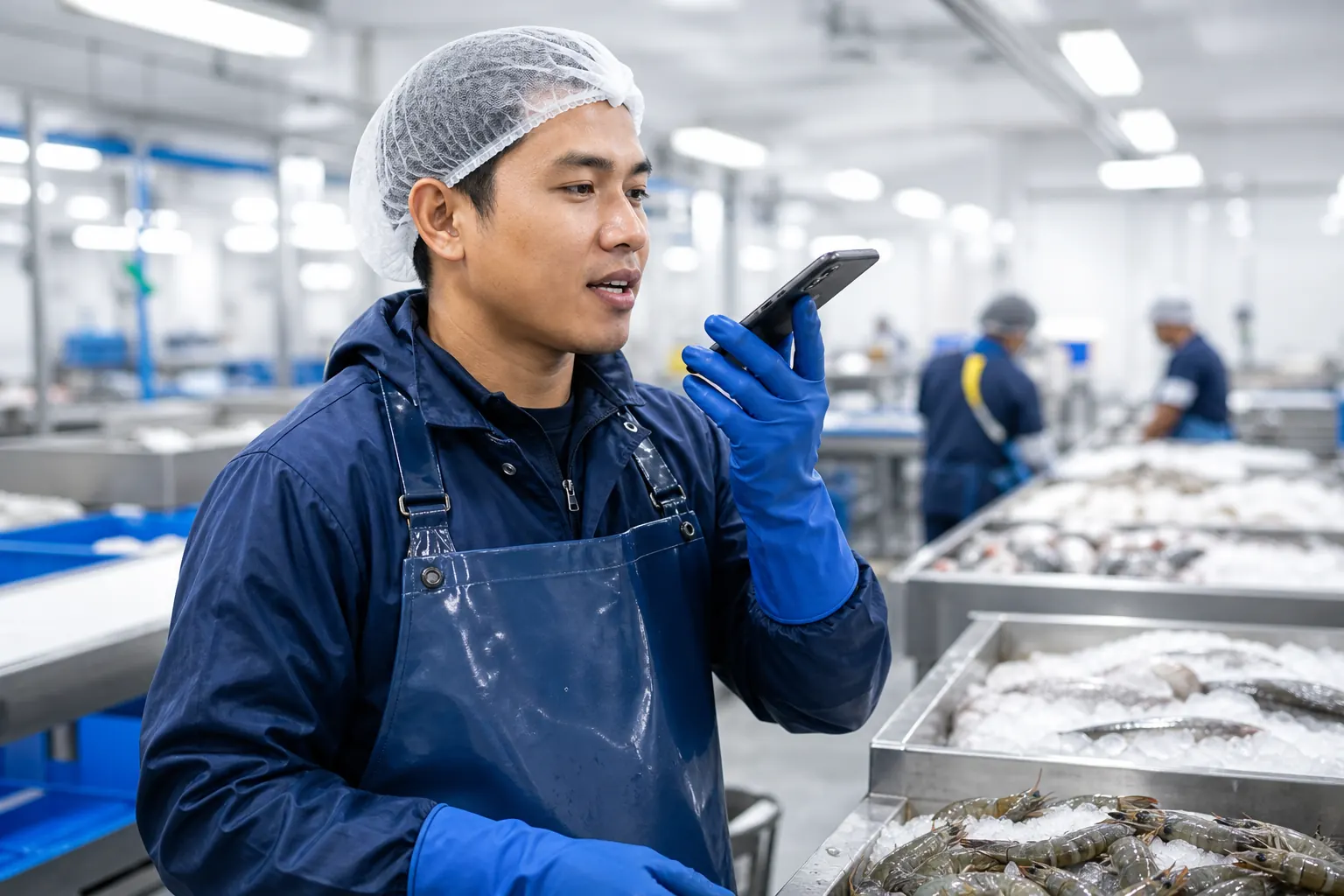
Seafood & fish processing
Processing-line hygiene, freezer protocols, and catch-handling vocabulary

Construction & skilled trades
Jobsite safety (OHS) and technical terminology

Manufacturing & assembly
Assembly lines, quality checks, and production-floor protocols

Warehousing & industrial
Forklift zones, loading docks, and warehouse safety protocols

Transport & logistics
Dispatch radio, route coordination, and last-mile delivery protocols

Your sector
Need a lexicon we have not listed? We configure workplace scenarios around your protocols
CNESST · named audit trail
A named readiness record — not an anonymous score
Proof that Worker X verified Protocol Y on Date Z
When CNESST or an internal safety review asks what was delivered and understood, you need a per-worker record — not a vague completion rate. Exportable readiness scorecards show who practiced which floor protocols, with a clear status before certified SST training. This is diligence for Operations and Risk, not a language certificate.
OQLF · francization file
Active integration for your francization goals
A measurable simulator that builds French workplace confidence — and produces evidence for your file
HR gives workers a voice simulator to actively practice French on the floor, not just a checkbox. Every session builds measurable workplace confidence, and the exportable comprehension records it produces can support internal onboarding files and, where the process allows, your OQLF francization documentation. It works alongside — not as a substitute for — your existing francization committee work and EIMT/CAQ compliance process.
Press
The press talks about us
Danguage deploys solutions recognized by the innovation ecosystem

Portrait on immigrating to Quebec and building Danguage to help newcomers integrate through profession-specific French

Coverage of Danguage's launch with support from Entrepreneuriat ULaval

Danguage (formerly Matchata) as an EUL-incubated company — technological innovation serving professional integration
Coverage of the French Tech Toronto annual summit, where Danguage was presented as a leading AI platform for language training
Law 25 & PIPEDA
Canadian-hosted voice. Your workers stay protected.
Voice data is processed on Canadian infrastructure and never used to train public foundation models. Law 25 and PIPEDA-aligned architecture so you can focus on safe onboarding — not another privacy review.
Sovereign, locally hosted AI
Simulations run on sovereign AI models hosted in locally controlled infrastructure
No sensitive audio is sent to foreign consumer AI services
Law 25 & PIPEDA by design
Consent, retention, and access follow Quebec’s Law 25 and federal PIPEDA from the first session
Privacy impact documentation is available for your compliance team
Biometric data protection
Voice recordings are processed as biometric data with strict access controls
Candidates practice freely knowing their data stays protected and auditable
Danguage
Ready to secure your floor?
Start with one line. Get a sample readiness scorecard for your plant and role — then decide on a 30-day pilot.
Operational in 48 hours. No LMS, no hardware, no IT project. $2,500 pilot credited in full against your annual plan.